


FIXING OUR ECONOMIC SYSTEM
Did you know there are well over 20 different variations of Capitalism?
Republicans often claim to believe in Laissez-Faire Capitalism, but somewhere between Nixon and Reagan, both Republicans and many Democrats shifted the country toward what we actually have today: Corporate Capitalism.
Meanwhile, whether they realize it or not, most Democrats, including progressives / liberals, support Social Market Capitalism. Very few actually believe in State Capitalism, let alone Socialism or Communism (which Trump supporters may not realize are real terms with specific definitions).

Over the past hundred years, the last time America truly worked for most Americans was after World War II, when inequality was low, upward mobility was high, and taxes on the wealthiest were more than double what they are today. In other words, it was before we converted to Corporate Capitalism.
This is not just about tax rates. It's about building a smarter system that rewards good behavior, invests for the long term, and benefits everyone. But, instead of doing that, our leaders wasted countless trillions of dollars, leaving us with a national debt exceeding $38 trillion.

YOU HAVE BEEN LIED TO FOR DECADES BY YOUR "REPRESENTATIVES"

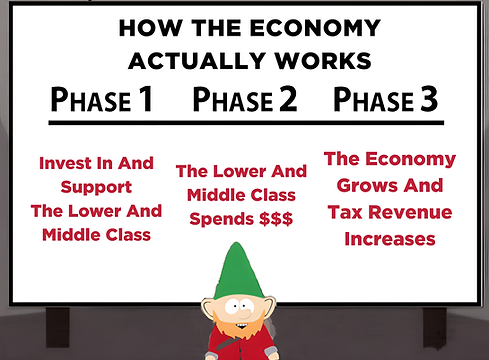
Our economy currently runs on the Friedman Doctrine, which says corporations should do only what’s best for shareholders, with zero responsibility to their country, communities, or even humanity. But in that case, why shouldn’t corporations be evil or break the law when the worst penalty is a relatively small fine?
In other words, our current economic framework makes crime and abuse rational business models. So our system is neither broken nor stupid. It is working exactly as designed! It just wasn’t designed for us.
Which means it is time to flip the script. Literally!
I AM PROPOSING A NEW ECONOMIC PHILOSOPHY FOR THE DEMOCRATIC PARTY:

OUR CURRENT SYSTEM REWARDS THE WORST BEHAVIOR (EXPLOITATION) AND PUNISHES THE BEST (ALTRUISM)
Trickle-Up Economics prioritizes smart, holistic investment in small businesses and everyday Americans, who spend and circulate their income throughout the economy rather than hoarding it.
That is why many public investments, like free universal pre-school, have such a high return on investment (ROI) that they pay for themselves over time.
Meanwhile, stupid investments, like tax cuts for the wealthy, deliver near-zero or often net negative benefits.


So what now? The sad truth is that nothing will truly change until we are no longer "represented" by wealthy sociopaths who in reality just represent even wealthier sociopaths.
TO CREATE THE SOCIETY WE WANT, OUR #1 PRIORITY MUST BE ENDING CORRUPTION BY ELIMINATING MONEY FROM OUR POLITICAL SYSTEM!
NON-EXHAUSTIVE LIST OF POLICY PROPOSALS
-
INCREASE TAXES ON THE WEALTHIEST 10%
- MOVE TO FOUR DAY & 30 HOUR WORK WEEK
- PAID SICK LEAVE & ONE YEAR FAMILY LEAVE
- EXPAND INFRASTRUCTURE INVESTMENT
- FUND THE IRS TO GO AFTER TAX EVASION
- UNIVERSAL CHILDCARE (FREE OR SUBSIDIZED)
- TARGETED GUARANTEED BASIC INCOME
-
LOWER TAXES ON THE MIDDLE & LOWER CLASS
- RAISE THE MINIMUM WAGE TO A LIVING WAGE
- STRONGER ANTITRUST RULES & ENFORCEMENT
- END ALL CORPORATE WELFARE (NOT INCLUDING WISE INVESTMENTS LIKE CLEAN ENERGY)
- FEDERAL JOBS GUARANTEE WITH FREE TRAINING
- OPPOSE STOCK BUYBACKS & TAX HOLIDAYS
FOR MORE INFORMATION TO SUPPORT TRICKLE-UP ECONOMICS
-
People, Power, and Profits: Progressive Capitalism for an Age of Discontent. Stiglitz, J. E. (2019). W. W. Norton & Company.
-
Utopia for Realists: How We Can Build the Ideal World. Bregman, Rutger. (2017). Little, Brown and Company.
-
Redistribution, Inequality, and Growth. Ostry, Berg, and Tsangarides. 2014. International Monetary Fund. SDN/14/02.
-
In It Together: Why Less Inequality Benefits All. OECD. 2015.
-
World Development Report: Learning to Realize Education’s Promise. World Bank. 2018.
-
Skill Formation and the Economics of Investing in Disadvantaged Children. Heckman, James J. 2006. Science, Vol. 312.
-
Where Is the Land of Opportunity? Chetty, Raj et al. 2014. Quarterly Journal of Economics, 129(4), 1553–1623.
-
The Price of Inequality: How today’s divided society endangers our future. Stiglitz, Joseph. 2012. W. W. Norton & Company.
-
Policies for Increasing Economic Growth and Employment. Congressional Budget Office. 2012. Economic Effects of Policies.
-
Growth Forecast Errors and Fiscal Multipliers. Blanchard, Olivier, and Daniel Leigh. 2013. American Economic Review.
-
Distributional National Accounts. Piketty, Thomas et al. 2018. Quarterly Journal of Economics, 133(2), 553–609.